
Strut channel — also called C-channel — is the steel channel that holds a cable tray system up. It forms the posts, the cantilever arms and the trapeze frames that the tray sits on, and it carries the whole weight of the tray, the cables and the fittings. The two sizes buyers order most are 41×41 and 41×21. They look similar, but the section depth decides what each one can carry — and choosing the wrong one is the most common support mistake on a tray installation.
| Channel | Section | Depth | Typical use |
|---|---|---|---|
| 41×41 | 41 mm wide × 41 mm deep | Deep section | Posts, cantilever arms and trapeze frames carrying tray runs |
| 41×21 | 41 mm wide × 21 mm deep | Shallow section | Light supports, short arms and bracing where the load is small |
What strut channel is
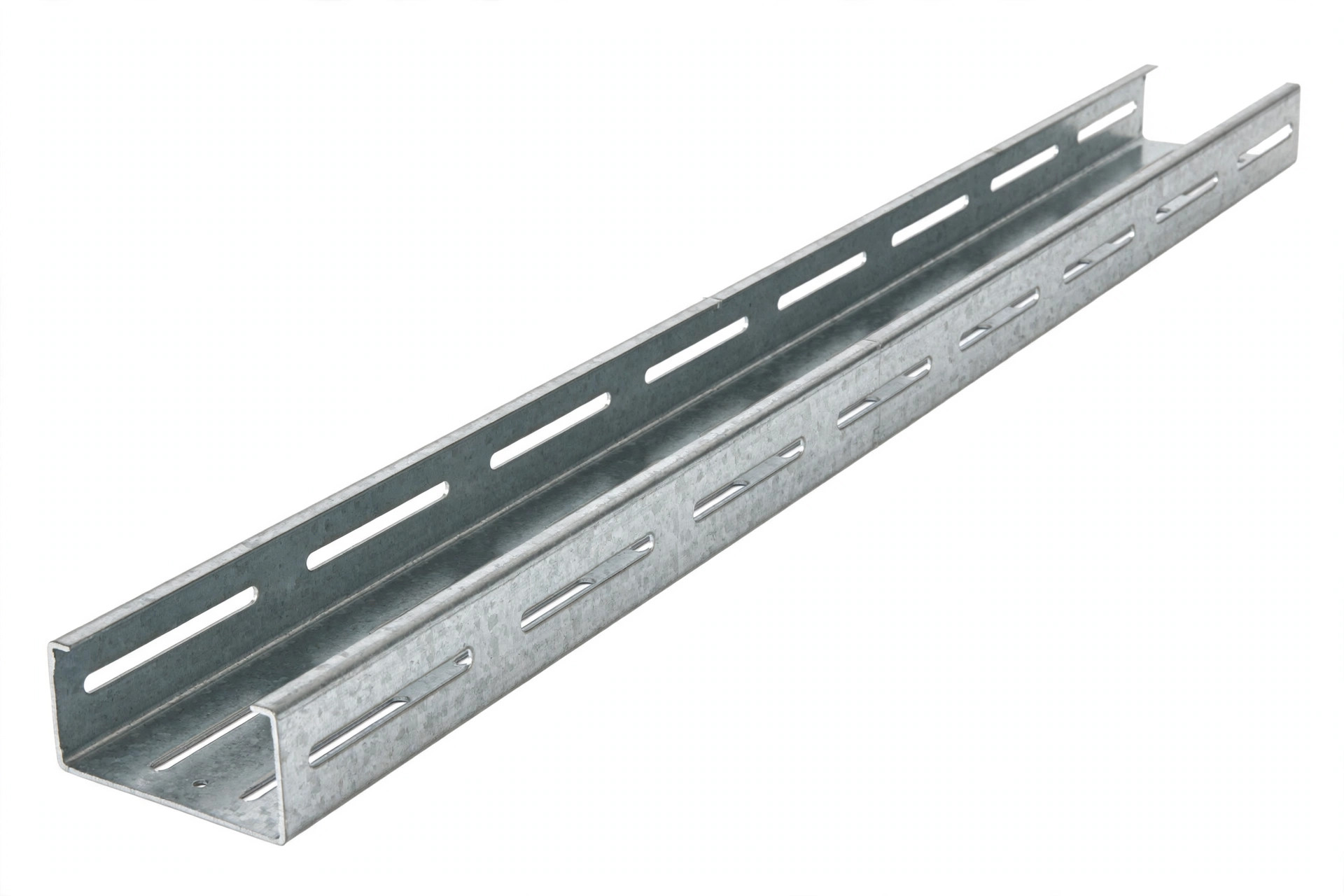
Strut channel is a cold-formed steel channel with a C-shaped cross-section, slotted along its length. The slots take spring nuts and bolts, so brackets, arms and tray can be fixed at any point without drilling — and moved later without cutting the channel. That adjustability is the reason it is used for almost every tray support: posts bolted to the wall or floor, cantilever arms carrying the tray, and trapeze frames hung from the ceiling.
The channel works as a system with its fixings: spring nuts, bolts, base plates, brackets and end caps. A support is only as strong as its weakest part, so the fixings are ordered with the channel, in the same finish, and the base plate is sized to the load the post carries.
What the section depth decides
The depth of the section is what gives the channel its stiffness. A 41×41 channel is 41 mm deep; a 41×21 channel is 21 mm deep — half the depth, in the same 41 mm width. The deeper section resists bending far better, so it carries heavier tray runs over longer spans, and it is the section used for posts and cantilever arms that carry the full weight of a loaded tray.
The 41×21 channel is the light-duty section. It suits short arms, light tray runs with few cables, and bracing — places where the load is small and the span is short. Using it where a 41×41 belongs is the mistake to avoid: the arm bends, the tray sags, and the fixings take a load they were not sized for. Where the load is not known, the deeper section is the safer choice, and the exact load and span are confirmed against the specification and the BOQ before ordering.
Loads and spans: how they are confirmed
How much a strut channel support carries depends on the tray it holds, the cables inside it, the span between supports and the way the load is applied — a cantilever arm, a trapeze frame and a wall post do not load the channel the same way. No single load number covers every case, so no load figure is published here: the load and span for each support are confirmed against the specification and the BOQ, with the tray type, width and cable weight on the quotation.
What the buyer should send is the information that decides the support: the tray type and width, the cable weight or fill, the support spacing on the drawing, and the fixing condition — wall, floor, ceiling or steelwork. With that, the channel size, the thickness and the fixing are confirmed on the quotation, and the support is sized to the run it carries rather than guessed from a catalogue line.
BS 6946: what the standard covers
BS 6946:1988 is the British Standard for metal channel cable support systems. It covers the channel, its fittings and its fixings as a support system — the dimensions, the materials and the way the parts are tested — so a support built to it can be checked against a written standard rather than a supplier's word. It is a support standard, not a tray standard: cable tray and cable ladder systems themselves fall under IEC 61537 (IEC 61537).
Where a project specification names BS 6946, the channel and its fittings are supplied to match it, and the factory's own channel data — sizes, material and thickness, and load and deflection figures — is provided with the quotation so the support can be checked against the specification. Where the specification names a different standard, send it with the BOQ and the channel is matched to that standard instead.
Finishes and fixings
Strut channel is supplied in the same finishes as the tray system: pre-galvanized, hot-dip galvanized, stainless steel 304/316 and powder coated. The finish is chosen for the environment — hot-dip galvanized for outdoor and coastal work, stainless steel where corrosion is severe — and the fixings match the channel finish, so the whole support weathers the same way. A galvanized channel with plain steel bolts rusts at the bolts first.
Our factory makes 20,000 m of strut channel per day, so channel is supplied in full lengths with the fixings to match: spring nuts, bolts, base plates, brackets and end caps, each as a separate line on the BOQ. The channel is also the support for cable ladder runs, where the ladder sits on cantilever arms fixed to channel posts — the same channel, the same fixings, the same finish.
Ordering strut channel by BOQ
Order by BOQ: channel size (41×41 or 41×21), thickness, finish and length, then the fixings — spring nuts, bolts, base plates and brackets — each on its own line, with the count taken from the support drawing. A support schedule that lists only the channel length and forgets the fixings leaves the installation crew short on site.
Send the support drawing or the support spacing with the BOQ, with the tray type and width each support carries. Quotations are prepared per BOQ — no fixed price list — and the channel size, thickness and fixings are confirmed against the specification before the quotation is issued.
Need strut channel sized for your tray runs?
Send your BOQ with the channel size, support spacing and the tray each support carries — Jason replies personally with a priced offer, channel and fixings on separate lines.
Frequently asked questions
What is the difference between 41×41 and 41×21 strut channel?
The depth: 41×41 is 41 mm deep, 41×21 is 21 mm deep, both 41 mm wide. The deeper section is stiffer and carries heavier tray runs; the shallow section suits light supports, short arms and bracing.
Can I use 41×21 channel for a cable tray support?
Only where the load is small and the span is short. For posts and cantilever arms carrying a loaded tray run, 41×41 is the usual choice. The exact load and span are confirmed against the specification and the BOQ.
What does BS 6946 cover?
BS 6946:1988 is the British Standard for metal channel cable support systems — the channel, its fittings and its fixings. Cable tray and ladder systems themselves fall under IEC 61537.
Are spring nuts and bolts included with the channel?
No, fixings are ordered as separate lines: spring nuts, bolts, base plates and brackets, in the same finish as the channel. List them on the BOQ with the count from the support drawing.
Get a quotation for your project
Send your BOQ or drawings and the tray type, size, finish, and quantity you need. Quotations are prepared per BOQ — no fixed price list — and cover trays, fittings, and accessories to match. WhatsApp: +86 195 6350 7326 · Email: [email protected]