
A cable tray cover is a lid that closes the top of the tray. It keeps rain, dust and falling objects off the cables, and it keeps the cables out of sight where the run passes through a public or finished area. A cover is not needed on every run — most indoor trays work open — but where the specification calls for one, or where the environment demands it, the cover is ordered with the tray, in the same size and finish.
| Cover type | What it does | Use it when |
|---|---|---|
| Solid flat cover | Closes the tray with a flat steel lid | Indoor and outdoor runs that need full protection |
| Peaked cover | Flat lid with a raised centre ridge | Outdoor runs where rain must run off |
| Ventilated cover | Lid with slots or louvers for air flow | Cables run hot but still need a lid |
| No cover | Tray left open | Clean indoor runs, easy access for changes |
When a cover is needed
Start with the environment, not the catalogue. A cover is needed where something falls or drips onto the run: outdoors under rain, in a plant where dust settles from above, above a walkway or a production line, or where the tray passes through a public area and the cables should not be visible or touchable. It is also needed where the specification says so — many project specifications call for covers on all outdoor runs and on all runs above occupied areas, and that instruction is followed as written.
Where a cover is not needed, an open tray is the better choice. An open tray is easier to inspect, easier to add cables to, and it ventilates the cables, which keeps them cooler. Most indoor runs in offices, data rooms and clean plant areas are left open for exactly those reasons. A cover adds weight and cost to the run, and it adds a step to every future cable change — so it belongs where it earns its place.
Solid flat covers
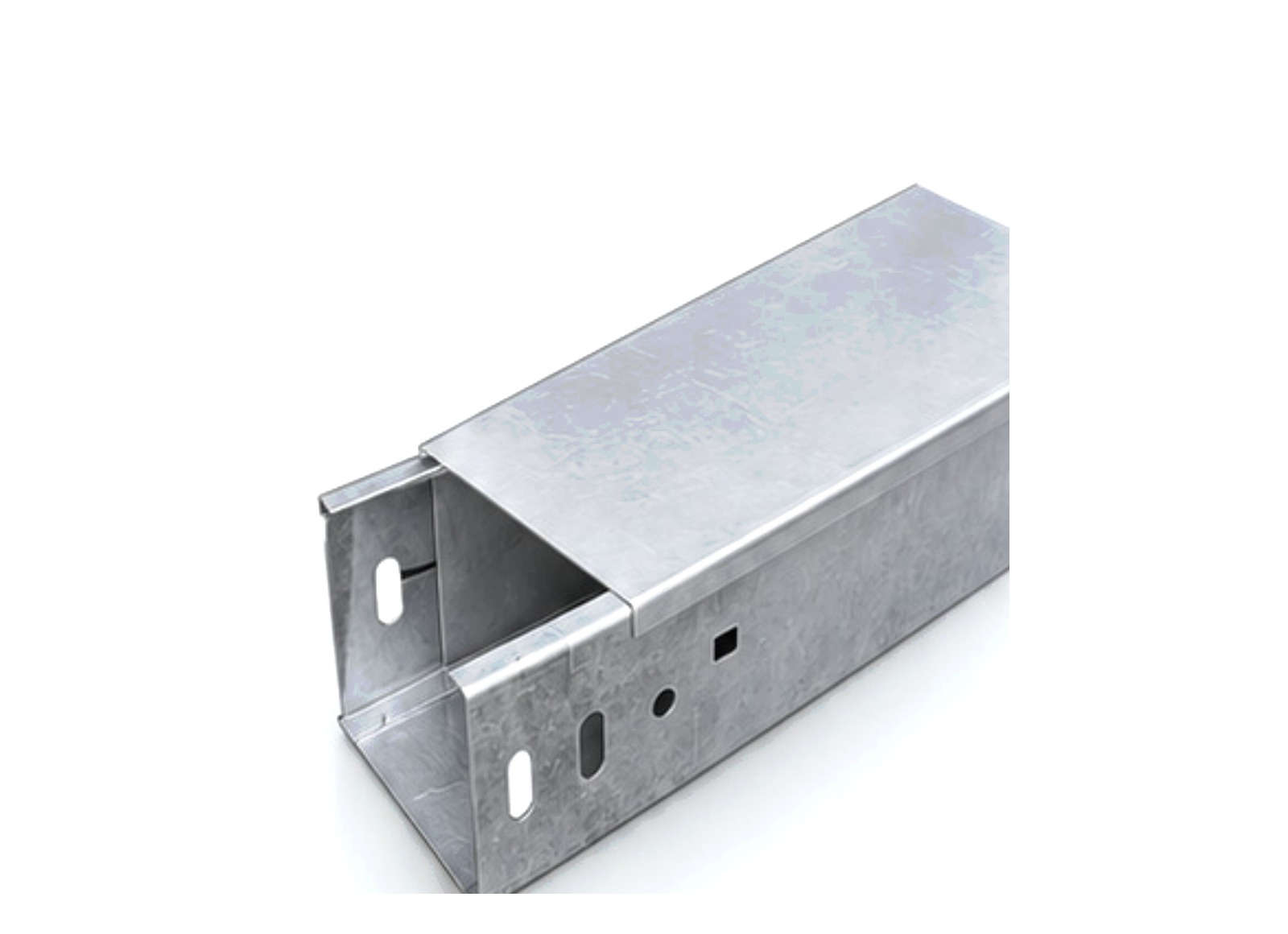
The solid flat cover is the standard lid: a flat steel sheet that sits on the tray side rails and closes the top. It is supplied in the same width as the tray and in the same finish — pre-galvanized, hot-dip galvanized, stainless steel or powder coated — so the covered run weathers the same way as the tray beneath it. It fits trough cable tray and perforated tray alike, and it is the cover most projects order.
Flat covers are held in place with cover clips, which hook over the side rails and press the lid down. Order the clips with the covers — they are small, they are easy to forget, and a cover without clips lifts in the wind. On long outdoor runs, clips are fitted at regular intervals along each cover length so the lid stays seated.
Peaked covers
A peaked cover is a flat cover with a raised ridge down the centre, so rain runs off to both sides instead of pooling on the lid. It is the cover for outdoor runs in heavy rain, and for any run where standing water on the lid would rust the finish or drip onto the cables when the lid is lifted. The ridge also stiffens the lid, which helps on wider trays.
Peaked covers cost more than flat covers and take more space above the tray, so they are ordered for outdoor runs and skipped indoors. Where the run is outdoors and the specification does not name a cover type, a peaked cover is the safe choice — it does everything a flat cover does, and it sheds water better.
Ventilated covers
A ventilated cover has slots or louvers punched in the lid, so air moves through while the lid still shields the cables from above. It is the compromise between an open tray and a solid cover: the cables stay covered, but heat can escape. It suits indoor runs where cables run hot and the area above the tray is dusty, or where the specification asks for a cover but the cable load is high.
Ventilated covers do not keep out fine dust or dripping water as well as a solid cover — the slots that let air through also let dust through. Where the run is outdoors in rain, a solid or peaked cover is the right choice instead. Match the cover to the threat: solid against water and dust, ventilated against heat.
Matching the cover to the tray
Three things must match: width, finish and length. The cover width matches the tray width — a 300 mm cover goes on a 300 mm tray — and the finish matches the tray, so a hot-dip galvanized cable tray gets a hot-dip galvanized cover. Covers are made in the same straight lengths as the tray, and cover fittings — bends, tees and reducers — are made to match the tray fittings they sit over, so a covered bend has a covered fitting.
Covers also fit the fittings in the fittings and accessories range: a cover on a bend needs a bend cover, and a cover on a tee needs a tee cover. Count the cover fittings from the same fitting schedule as the tray fittings — every bend, tee, cross and reducer that is covered needs its own cover piece.
Ordering covers, clips and fittings
Order covers as separate lines on the BOQ: cover type, tray width, finish and length, then the cover fittings by type, then the clips. A common mistake is ordering the covers and forgetting the clips, or ordering covers for the straight runs and forgetting the covers for the bends — both leave the run half finished on site.
Covers follow the same standard as the tray system, IEC 61537, which covers cable tray systems and cable ladder systems including their performance and test requirements (IEC 61537). Quotations are prepared per BOQ — no fixed price list — and covers, cover fittings and clips are priced as separate lines, so the count on the drawing is the count on the quotation.
Need covers for your tray runs?
Send your BOQ with the cover type, tray widths and the areas each run passes through — Jason replies personally with a priced offer, covers, fittings and clips on separate lines.
Frequently asked questions
Do all cable trays need covers?
No. Most indoor trays work open — open trays are easier to inspect, easier to add cables to, and they ventilate better. Covers belong outdoors, in dusty plants, above walkways, or wherever the specification calls for them.
Can a cover be added to a tray that is already installed?
Yes, if the tray is the standard type and the cover width matches. Covers and clips are supplied to fit the tray sizes in the catalog range, 50–1200 mm wide. Send the tray width and finish so the cover is matched correctly.
Do covers trap heat in the tray?
A solid cover slows heat loss, because the heat can only escape from the open ends. Where cables run hot and a cover is still needed, a ventilated cover is the better choice — it shields the cables from above while letting air through.
Are cover clips included with the covers?
No, clips are ordered as a separate line. List them on the BOQ with the covers, so the lids are fixed in place on day one. Cover fittings for bends, tees and reducers are also separate lines.
Get a quotation for your project
Send your BOQ or drawings and the tray type, size, finish, and quantity you need. Quotations are prepared per BOQ — no fixed price list — and cover trays, fittings, and accessories to match. WhatsApp: +86 195 6350 7326 · Email: [email protected]