
A wire mesh cable tray is a tray made from welded steel wire — a grid of longitudinal and transverse wires, formed into a U-shaped basket that carries cables. It is light, open and quick to install, and it is the tray most often chosen for data cables: network, telephone and control cabling in data centers, offices and commercial buildings. It is not a heavy-load tray — knowing where it wins and where it stops is the whole guide.
| Feature | Wire mesh tray | What it means on site |
|---|---|---|
| Construction | Welded steel wire grid, U-shaped basket | Light to carry and to hang; easy to cut and shape |
| Ventilation | Open grid, air flows through freely | Data cables stay cool; heat does not build up |
| Straight sections | 3000 mm long, 5.0 mm wire, widths to 600 mm | Other sizes confirmed with your quotation |
| Support spacing | 1.0 / 1.5 / 2.0 / 3.0 m, by wire diameter and width | Spacing is chosen from the catalog tables, not guessed |
| Best use | Data, telephone and control cables | Light loads; not the tray for heavy power runs |
What wire mesh tray is
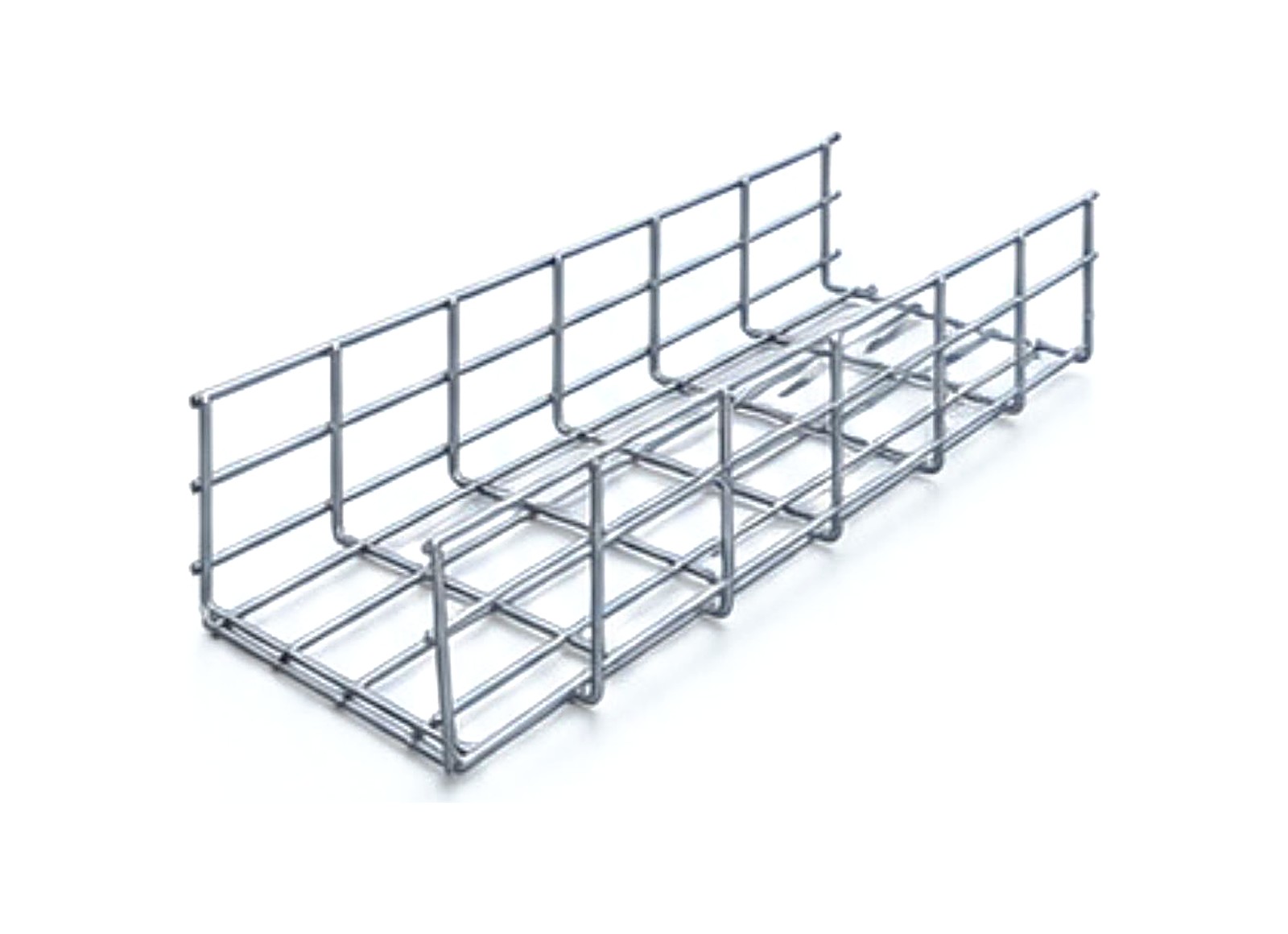
Wire mesh tray is made by welding steel wires into a grid and bending the grid into a shallow basket with raised sides. There is no solid bottom or side rail — the wires themselves are the tray. Our published straight sections are 3000 mm long, in 5.0 mm wire, in heights of 50, 85, 100 and 150 mm and widths to 600 mm; accessories fit wire diameters from 3.5 to 6.0 mm.
The open grid is the point of the design. Air moves through it, so cables cool; dust falls through instead of collecting; and a cable can be dropped into the tray from above at any point along the run, without threading it through from the end. In a data center, where cables are added and changed often, that open access is worth more than the extra strength of a solid tray.
Where it wins: data cables
Wire mesh tray wins wherever the load is light and the cables change often. Data centers are the clearest case: mesh carries the data runs above the server racks while a cable ladder carries the heavier power feeds below — two systems in one room. The same logic applies in offices and control rooms, where data and telephone cabling is reworked as systems change.
It also wins where the route is complicated: cut and bent on site, a mesh run can turn, rise and drop around beams and ducts without factory-made fittings. Our cable tray for data centers guide lays out the two-system room in detail.
Sizes and support spacing
Published straight sections come in heights of 50, 85, 100 and 150 mm — CM50, CM85, CM100 and CM150 — 3000 mm long in 5.0 mm wire, with widths to 600 mm. Support spacing is chosen from the catalog support-spacing tables at 1.0, 1.5, 2.0 or 3.0 m, by wire diameter and width: a wider tray or a heavier cable load takes the shorter spacing. Widths over 600 mm, heights outside the published range and other wire diameters are confirmed with your quotation, not guessed from the table.
Two honest notes on the numbers. First, the catalog publishes no safe working load for mesh straight sections, so the load is selected from the support-spacing tables and stated on the quotation with the table and the unit used. Second, CM85 per-piece weights are not published — the catalog's CM85 weight column runs against the trend of the other heights, pending factory confirmation — so CM85 weight is confirmed with your quotation.
Installing it: cutting, bends and supports
Mesh tray is cut on site with a bolt cutter or angle grinder, and bends are made by cutting the side wires and folding the tray to the angle needed. No factory bend is required for most turns, which is one reason mesh installs quickly. Couplers join straight sections end to end and carry the electrical continuity across the joint — check that the couplers are fitted at every joint, because a missed coupler breaks the continuity of the run.
Supports are trapeze hangers or cantilever arms, fitted at the spacing the catalog tables give for the tray width and load. The spacing is still the rule: a mesh tray hung at ladder-tray spacing will sag, and a sagging tray is the first sign of a run installed without the tables. Couplers, brackets, hangers and dividers are in the fittings and accessories range.
Limits to respect
Wire mesh tray is not a heavy-load tray. It does not carry the power-cable loads a ladder tray carries, and it does not protect cables from falling objects or dripping water the way a solid tray with a cover does. It is not the tray for outdoor runs in heavy rain, for plant areas where objects fall from above, or where the specification asks for a closed tray. Where the load is heavy, the run is outdoors, or protection is specified, use a ladder or perforated tray, not mesh.
The other limit is fill. The open grid tempts installers to pile cables in, because there is no side wall to say stop. The fill ratio still applies: cables need air around them to cool, and an overfilled mesh tray loses the ventilation that is its main advantage. Keep the fill to the ratio the design allows, and add a second run before overfilling the first.
Ordering wire mesh tray on a BOQ
Ordering wire mesh tray on a BOQ
Order mesh tray by height, width, wire diameter, finish and length: "CM100, 300 mm wide, 5.0 mm wire, pre-galvanized, 3000 mm" is a complete line. Add couplers by count, supports by type and spacing, and dividers where power and data share a run. Our wire mesh cable tray page lists the published sizes; anything outside that range is confirmed with your quotation before it is ordered.
Mesh tray follows the same standard as the rest of the range, IEC 61537, which covers cable tray systems and cable ladder systems including their performance and test requirements (IEC 61537). Quotations are prepared per BOQ — no fixed price list — with the wire diameter, size and support spacing written on every line.
Planning a data cable run?
Send your BOQ with the tray sizes, the cable types and the areas each run passes through — Jason replies personally with a priced offer, mesh tray, couplers and supports on separate lines.
Frequently asked questions
Is wire mesh tray strong enough for power cables?
Mesh tray is built for light loads — data, telephone and control cables. Heavy power runs belong on a cable ladder or a perforated tray. Send the cable schedule and the load is checked against the tables before the quotation is issued.
What sizes is wire mesh tray supplied in?
Published straight sections are 3000 mm long, 5.0 mm wire, heights of 50, 85, 100 and 150 mm, widths to 600 mm; other sizes are confirmed with your quotation.
How far apart are the supports?
Support spacing is 1.0, 1.5, 2.0 or 3.0 m, chosen from the catalog tables by wire diameter and width — a wider tray or heavier load takes the shorter spacing.
Can wire mesh tray be cut and bent on site?
Yes — cut with a bolt cutter or angle grinder, bent by cutting the side wires and folding the tray. Couplers join the sections and carry electrical continuity across each joint.
Does wire mesh tray need a cover?
Usually not — mesh tray is used indoors, where the open grid gives ventilation and easy access for cable changes. Where protection from above is specified, a solid tray with a cover is the right choice instead.
Get a quotation for your project
Send your BOQ or drawings and the tray type, size, finish, and quantity you need. Quotations are prepared per BOQ — no fixed price list — and cover trays, fittings, and accessories to match. WhatsApp: +86 195 6350 7326 · Email: [email protected]