
Cable trunking is a fully enclosed tray with a fitted cover, built for cables that need protection from interference, dust and moisture. Use it for sensitive control and communication cables, and for visible runs where the installation has to look finished. Use open tray where cables need airflow, frequent access, or heavy-load carrying over long spans.
| Question | Cable trunking | Open tray |
|---|---|---|
| Construction | Fully enclosed channel with fitted cover | U-channel with slotted base, open top — or ladder rails and rungs |
| Protection | Full cover keeps out dust, moisture and falling objects | Open top, needs a separate cover for protection |
| Interference shielding | Closed steel section shields sensitive cables | Little shielding |
| Ventilation and heat | Lowest — enclosed section holds heat | Slots give some airflow; ladder is fully open |
| Access to cables | Cover must be removed | Open top, cables lift straight out |
| Appearance | Neat, finished — suited to visible runs | Industrial, open |
| Typical cables | Computer, communication, thermocouple, sensitive control | General power and control; heavy power on ladder |
What cable trunking is
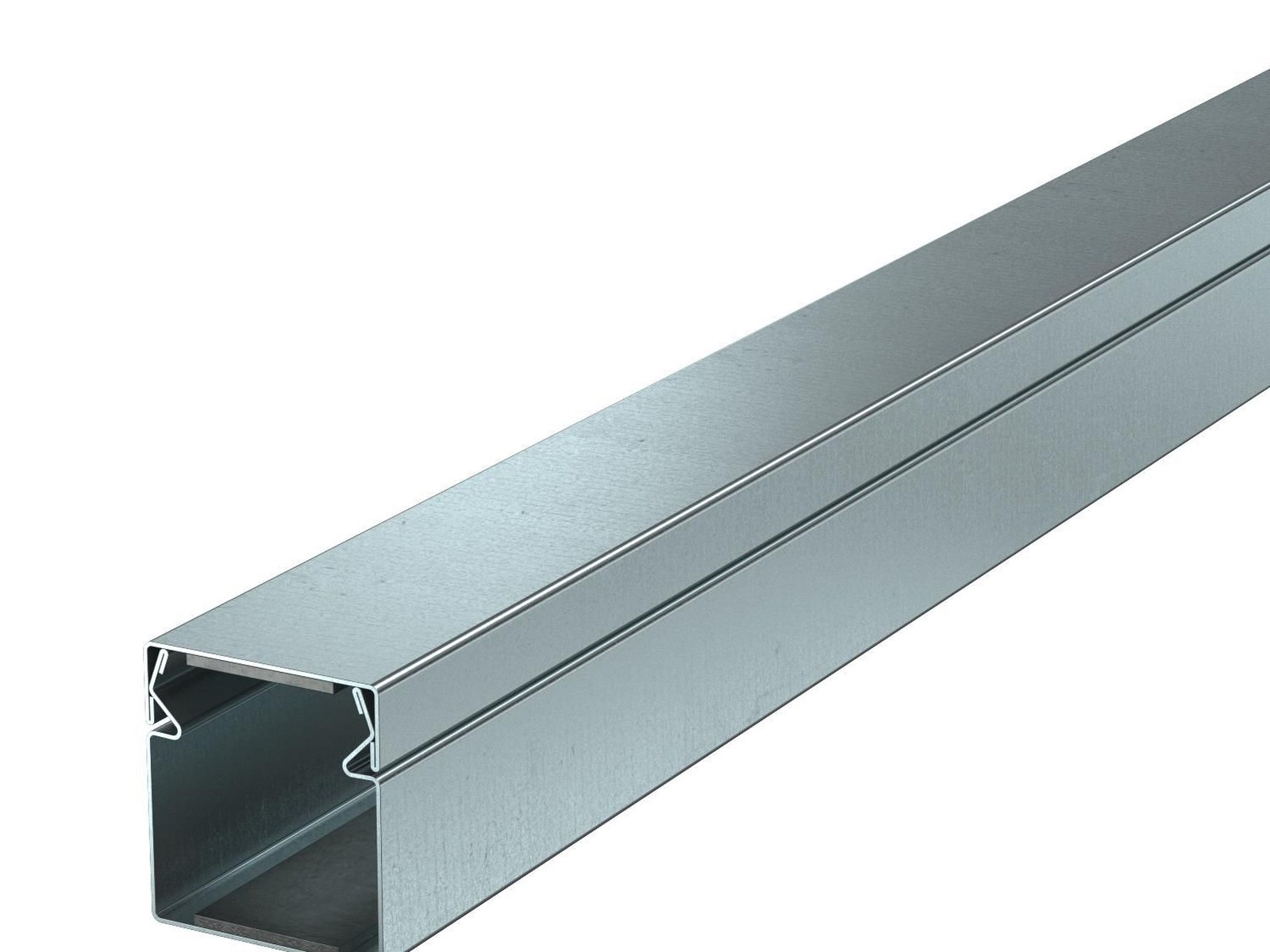
Cable trunking is a fully enclosed, solid-bottom tray with a fitted cover. The cover closes the section completely, so the cables inside are shielded from electromagnetic interference and kept clear of dust and moisture. It is built for computer cables, communication cables, thermocouple cables and other highly sensitive control cables — the cables whose signals suffer first when they run unprotected beside power circuits.
Our trunking range is 50 to 1200 mm wide, 10 to 200 mm high and 0.5 to 3.0 mm thick, in Q235 steel, stainless steel 201, 304 and 316, and aluminum 6061-T6 and 6063-T5. Finishes run from pre-galvanized 40, 80 and 275 g/m² and hot-dip galvanized 45, 65 and 85 µm through ZAM to powder coated in a colour the project specifies. Covers are formed to the trunking width and packed with their clamps, and fittings are made to match the section and finish.
When to enclose the cables
Enclose the cables when the signal matters more than the airflow. Control and communication cables pick up interference from nearby power circuits, and a closed steel section around them is the simplest protection available — no separate shielding, no extra conduit, just the trunking itself.
Enclose them when the environment attacks from above. Dust settles into an open tray, washdown water falls into it, and anything dropped from a walkway lands on the cables. Trunking keeps all three out, which is why it is specified for chemical plants, coastal sites, high-rise buildings, subway tunnels and plant corridors.
Enclose them when the run is visible. A trunking run along a corridor ceiling or a public area looks finished: a clean rectangular section with a fitted cover, joints in line, no cables on show. A cover fitted to an open tray never sits as neatly as a cover made for a trunking section. Where appearance is part of the specification, trunking is the answer.
When open tray is the better choice
Do not enclose cables that need to lose heat. Power cables running near their rated current give off heat, and an enclosed section holds it in. A cable ladder gives the most airflow of any tray type, and perforated tray gives some through its slots — both run cooler than trunking for the same cables. If the cable schedule is tight and the derating margin is small, open tray is the right call and trunking is the wrong one.
Do not enclose cables that are added to and changed often. Every change to a trunking run means removing covers, working inside a closed section, and refitting them — slow work compared with lifting cables into an open tray from above. Data rooms where circuits change often belong on open tray, usually wire mesh tray for data cables.
Do not enclose heavy power cables over long spans. Trunking is a formed channel, not a ladder, and long spans with heavy loads belong on a cable ladder, whose side rails carry the load further between supports. The section and span for any run are confirmed with your quotation.
Covers, fittings and finishes
A trunking order is not just straights. Bends, tees and reducers are made to the same section and finish, Covers are formed to the trunking width, so the cover and the section match exactly — a cover borrowed from another tray type will not sit right, and should not be ordered that way. See our fittings and accessories range for the matching parts.
The finish matters more than the gauge for corrosive or outdoor duty. In a chemical plant or a coastal site, the finish is chosen from the environment first — hot-dip galvanized, ZAM, stainless steel or powder coated — and the steel thickness second. Tell us the environment on the inquiry and the quotation recommends the coating from the catalog finishes table. Our cable tray finishes compared guide sets out where each finish belongs, and the standard that covers tray systems, including trunking, is IEC 61537.
Specifying trunking on a BOQ
Order trunking by the cable first and the size second. State what the cables are — computer, communication, thermocouple, control — and what they run beside, because that decides whether trunking is needed at all. Then state the width, height and thickness, the material and finish, and the fittings: bends, tees, reducers and the number of covers and clamps.
Where a project mixes trunking and open tray, list each type on its own BOQ line. The usual split is trunking for the sensitive control and communication runs, perforated tray for general power and control, and ladder for the heavy main runs. Each line is priced separately. Anything outside the published range — a width, a finish, a fitting — is confirmed with your quotation before it is ordered.
Running sensitive control or communication cables?
Send your BOQ with the cable types and the environment each run passes through — Jason replies personally with a priced offer, trunking, covers and fittings on separate lines.
Frequently asked questions
What is the difference between cable trunking and a cable tray with a cover?
Trunking is made as a closed section: the channel and its fitted cover are one system, formed to match. A cover on an open tray is an add-on, and it never sits as neatly or seals as well. Where the cables need real enclosure, order trunking; where they only need a lid against dust, a covered tray is enough.
Which cables belong in trunking?
Computer cables, communication cables, thermocouple cables and other sensitive control cables. These are the cables whose signals suffer from interference and moisture, and trunking shields them. Heavy power cables belong on open tray, usually a ladder, where they can lose heat.
Can trunking be used outdoors?
Yes, with the right finish. The enclosed section keeps rain and dust off the cables, but the finish has to suit the environment — hot-dip galvanized, ZAM or stainless steel for corrosive and coastal sites. State the environment on the inquiry and the quotation recommends the coating.
How do I add a cable to trunking later?
Remove the cover over the section, lay the cable in, and refit the cover. It is slower than adding a cable to open tray, which is why trunking suits fixed runs that rarely change. If circuits change often, use open tray for those runs and trunking for the fixed ones.
What sizes does trunking come in?
Widths 50 to 1200 mm, heights 10 to 200 mm and thicknesses 0.5 to 3.0 mm, in Q235 steel, stainless steel 201, 304 and 316, and aluminum 6061-T6 and 6063-T5. Custom sizes and drawings are accepted, and the exact size is confirmed with your quotation.
Get a quotation for your project
Send your BOQ or drawings and the tray type, size, finish, and quantity you need. Quotations are prepared per BOQ — no fixed price list — and cover trays, fittings, and accessories to match. WhatsApp: +86 195 6350 7326 · Email: [email protected]