
The finish on a cable tray is the layer that stands between the steel and the air around it. Choose the wrong finish and the tray rusts years before the cables inside it are replaced; choose the right one and the tray outlasts the installation. There are four finishes buyers order most: hot-dip galvanized, pre-galvanized, stainless steel and powder coated. They differ in how the coating is applied, how thick it is, and where each one belongs.
| Finish | Coating | Best for | Watch out for |
|---|---|---|---|
| Hot-dip galvanized | Zinc layer 45 / 65 / 85 µm, applied after fabrication | Outdoor, coastal and humid sites | Matte, rough surface; heavier zinc adds weight |
| Pre-galvanized | Zinc coating 40 / 80 g/m², applied to the sheet before forming | Dry indoor runs, offices, malls, plant rooms | Cut edges and welds are not re-coated |
| Stainless steel 304 / 316 | No coating — the grade itself resists corrosion | Food, chemical and wastewater plants | Highest material cost; grade must be stated |
| Powder coated | Colour coating over galvanized steel | Colour-matched and architectural runs | Coating can chip if handled roughly on site |
Hot-dip galvanized (HDG)
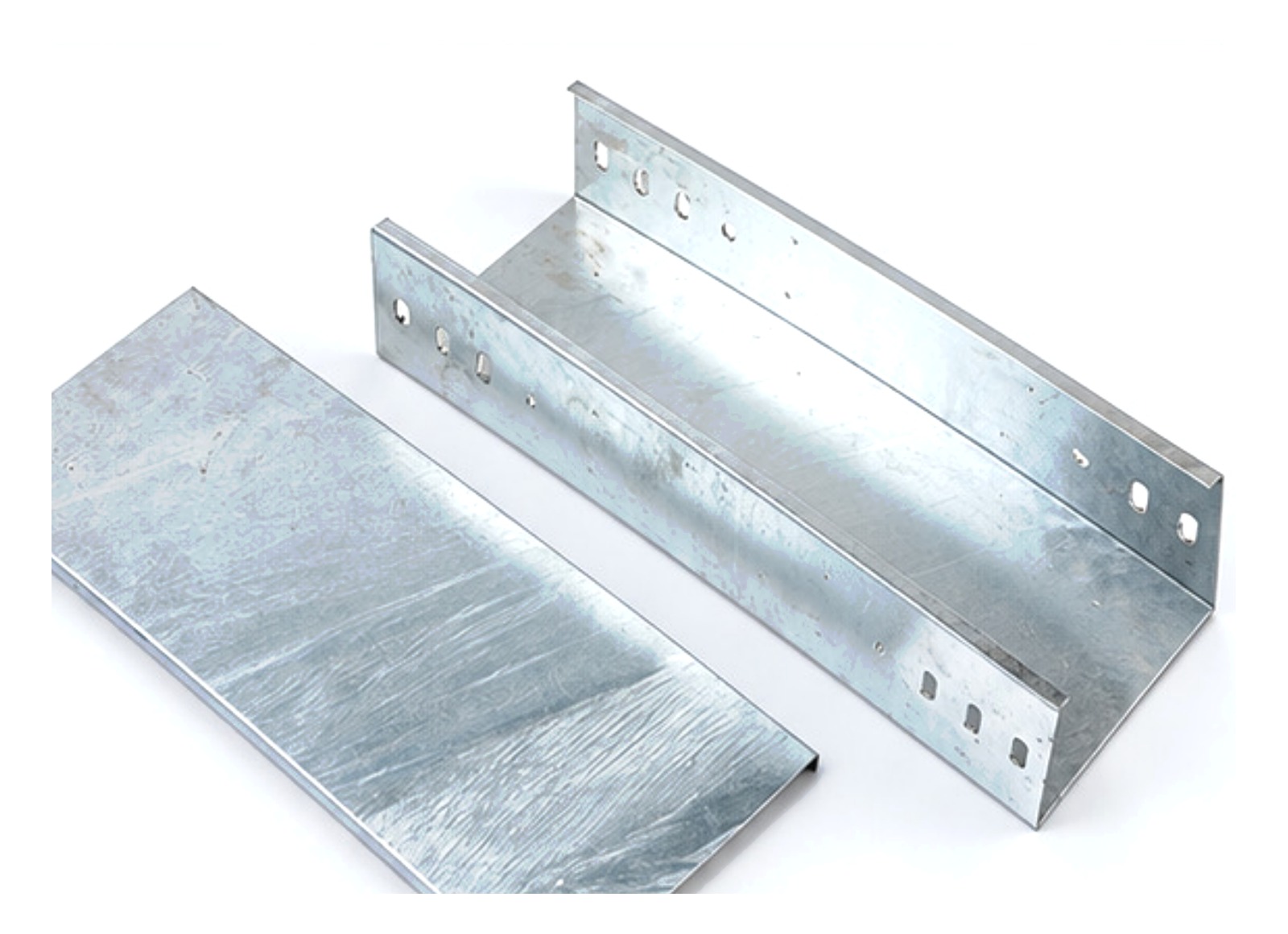
Hot-dip galvanizing is done after the tray is fabricated: the finished tray is dipped in molten zinc, so the coating covers the whole piece — the flat surfaces, the cut edges, the welds and the inside of the perforations. That is the reason it is the default finish for outdoor runs. The zinc layer is 45, 65 or 85 µm, stated on the quotation so the buyer can check it against the specification.
The surface is matte grey and slightly rough, with a spangle pattern where the zinc has crystallised. It is not a decorative finish — the roughness is the zinc doing its job. Where a project needs both heavy corrosion protection and a clean colour, HDG is coated again with powder (see below). A hot-dip galvanized cable tray is the finish to specify whenever the run is outdoors, near the coast, or in a humid plant, and the specification does not name stainless steel.
Pre-galvanized steel
Pre-galvanized steel starts as a sheet that is already zinc coated — 40 or 80 g/m² — and the tray is formed from that sheet. The finish is bright, smooth and even, and it costs less than hot-dip galvanizing, which is why it is the economical standard for indoor work. A galvanized cable tray in pre-galvanized finish belongs in dry indoor environments: offices, malls, plant rooms and light industrial runs where the air is clean and the tray stays dry.
The limit to know is the cut edge. Because the coating is applied before forming, the edges cut during fabrication and any welds are bare steel. Indoors, in dry air, that rarely matters. Outdoors, in rain or coastal air, those bare edges are where rust starts first. So the rule is simple: pre-galvanized indoors, hot-dip galvanized outdoors.
Stainless steel 304 / 316
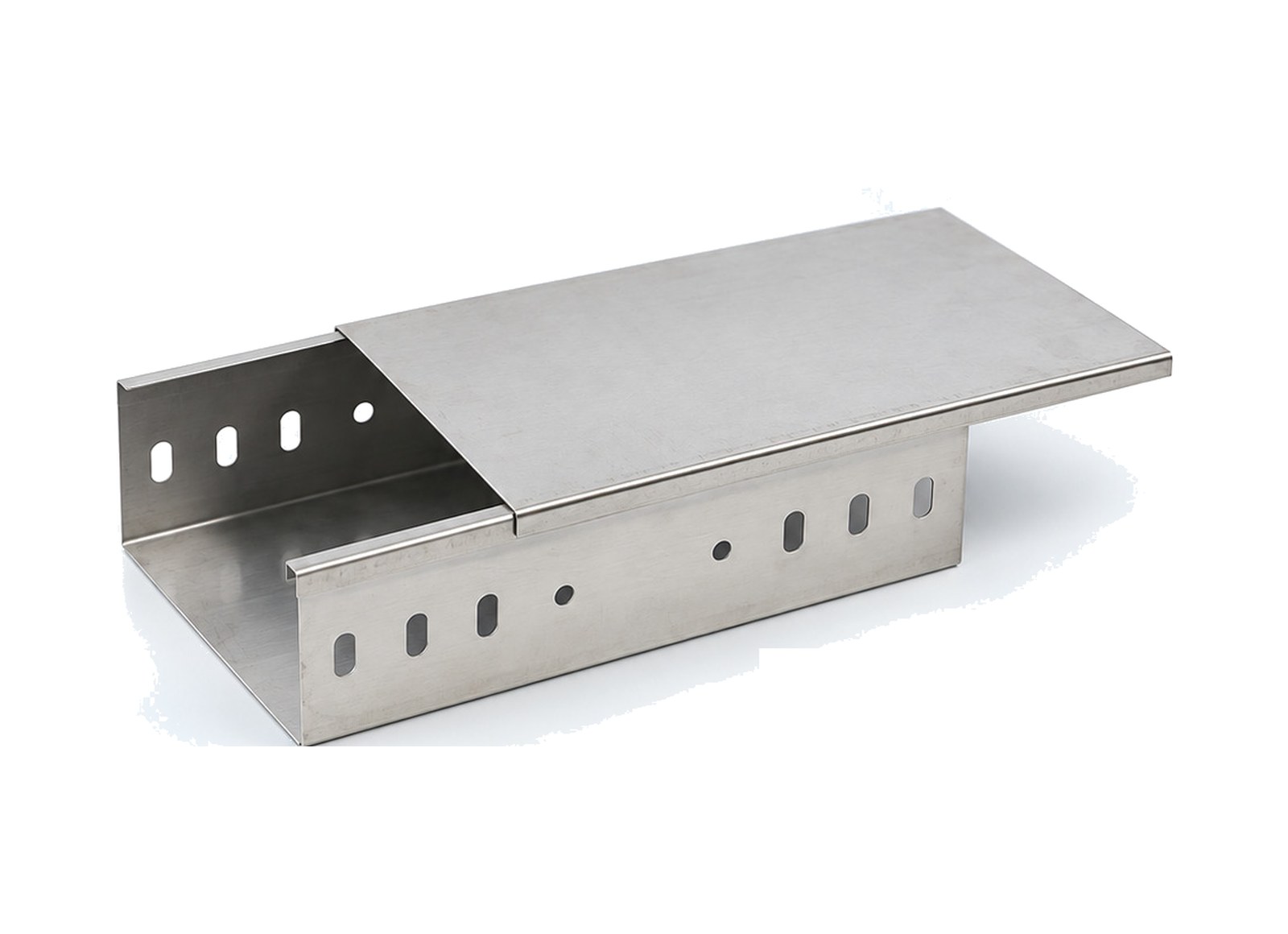
Stainless steel needs no coating at all: the corrosion resistance is in the grade itself. Grade 304 suits food processing, cleanrooms and wastewater plants; grade 316 adds molybdenum and suits chemical plants and coastal sites where chlorides are present. The surface is smooth, easy to clean, and it stays that way without repainting or re-coating.
Two things to get right on the order. First, state the grade — 304 and 316 are different materials at different prices, and a quotation that only says "stainless steel" leaves the grade open. Second, confirm the finish is the mill finish unless a brushed or polished surface is specified. Our stainless steel cable tray is supplied in 304 and 316, and the grade is written on the quotation and on the mill certificate.
Powder coated
Powder coating is a colour layer baked onto the steel, usually over a galvanized base — HDG plus powder is a common combination in our catalog. It gives a chosen colour and an extra barrier layer over the zinc, which is why it is specified where the tray is visible: lobbies, retail, airports and architectural plant rooms.
The colour is customisable, so the RAL colour is stated on the BOQ. The practical limit is handling: a powder coat can chip if the tray is dragged across concrete or struck by tools on site, and a chip exposes the steel beneath. A powder coated cable tray is ordered by colour, tray size and the galvanized base beneath it.
Choosing by environment
Start with where the tray will live, not with the price list. Dry indoor air takes pre-galvanized steel, or electro-galvanized with its thinner 8–25 µm layer where a smooth bright surface matters. Outdoor and humid sites take HDG at 45, 65 or 85 µm. Coastal and marine sites take ZAM-coated steel — a zinc-aluminium-magnesium coating at 80 or 275 g/m² with self-healing cut-edge protection — or HDG plus powder coating. Chemical, food and wastewater duties take stainless 304, or 316 where chlorides are present. Weight-sensitive runs take aluminum alloy, about 65% lighter than steel. The full range is on our materials and finishes page. To see what the material choice does to the weight of the same run, use our cable tray weight calculator — it works out the weight per metre in steel, stainless steel or aluminum.
One more practice that saves money on large projects: split the BOQ by area. The indoor runs get pre-galvanized, the outdoor and coastal runs get HDG or ZAM, and only the areas that need it get stainless. A single finish for the whole project is simpler to order, but it means paying the outdoor price for indoor trays.
Ordering finishes on a BOQ
Write the finish on every line of the BOQ, not just once at the top. Each line needs the tray type, width, height, thickness, length, finish and zinc layer or grade — "HDG 65 µm" or "stainless 316", not just "galvanized". Fittings and accessories take the same finish as the tray they join, and covers take the same finish as the tray they sit on. Where the specification names a coating thickness, send the specification with the BOQ so the quotation matches it line by line.
All finishes follow the same tray standard, IEC 61537, which covers cable tray systems and cable ladder systems including their performance and test requirements (IEC 61537). Quotations are prepared per BOQ — no fixed price list — and the finish, zinc layer or grade is written on each line, so what is quoted is what is manufactured.
Not sure which finish your site needs?
Send your BOQ with the finish you have specified — or just the areas each run passes through — and Jason replies personally with a priced offer, finish and zinc layer written on every line.
Frequently asked questions
What is the difference between pre-galvanized and hot-dip galvanized?
Pre-galvanized steel is zinc coated as a flat sheet before the tray is formed, so cut edges and welds are bare. Hot-dip galvanized trays are dipped after fabrication, so the zinc covers the whole piece including cut edges and welds. Pre-galvanized suits dry indoor runs; HDG suits outdoor and humid sites.
Which zinc thickness should I specify for outdoor trays?
Our HDG trays are supplied at 45, 65 or 85 µm. Most outdoor specifications ask for 65 µm; coastal sites usually ask for 85 µm. State the thickness on the BOQ.
Is stainless steel 304 enough, or do I need 316?
Grade 304 suits food, cleanroom and wastewater duties; grade 316 is needed where chlorides are present — chemical plants and coastal sites. If the specification names a grade, follow it.
Can powder coating go over hot-dip galvanizing?
Yes. HDG plus powder coating is a standard combination: the zinc gives the corrosion protection and the powder gives the colour and an extra barrier layer. State the RAL colour on the BOQ.
What is ZAM coating?
ZAM is a zinc-aluminium-magnesium coating, supplied at 80 or 275 g/m². It gives several times the corrosion resistance of conventional galvanizing and protects cut edges by itself. It is used for coastal, marine and chemical environments.
Get a quotation for your project
Send your BOQ or drawings and the tray type, size, finish, and quantity you need. Quotations are prepared per BOQ — no fixed price list — and cover trays, fittings, and accessories to match. WhatsApp: +86 195 6350 7326 · Email: [email protected]