
A steel cable tray is a long metal structure running through a building, so it must be earthed: every section bonded into one continuous conductive path, connected to the building earth. If one joint in that path is missed, the tray stops being a single earthed system and becomes separate pieces of metal. That is the failure this guide helps you specify against.
| What to state | What it means | How it is checked |
|---|---|---|
| Tray material and finish | Steel conducts, so the run can be earthed; coatings affect joints | Stated on the quotation, checked at delivery |
| Couplers at every joint | Couplers join sections and carry continuity across each joint | Counted on the BOQ, fitted at every joint on site |
| Bonding jumpers where specified | A copper jumper bridges a joint where continuity cannot be relied on | Listed as separate lines, fitted where the design states |
| Earth lug points | The tray run connects to the building earth at the points the design specifies | Lug positions marked on the layout drawings |
| Separate protective conductor | FRP runs need their own conductor, since FRP does not conduct | Specified by the project electrical design |
Why a cable tray needs earthing
The standard behind the requirement is IEC 61537, which covers cable tray and cable ladder systems including electrical continuity across joints. Whether the tray itself may serve as the protective conductor is a decision for the project electrical design — the specification must state it either way, and the quotation must answer the specification as written. Our cable tray standards explained guide sets out what the standard covers and what to check.
Earthing is not an accessory to the tray: it is part of the tray system. A run ordered without couplers, bonding jumpers and earth lugs is a run that cannot be earthed as specified, however good the straight sections are. That is why the earthing items belong on the same BOQ as the tray, counted from the same drawings.
Continuity across joints: the part installers miss
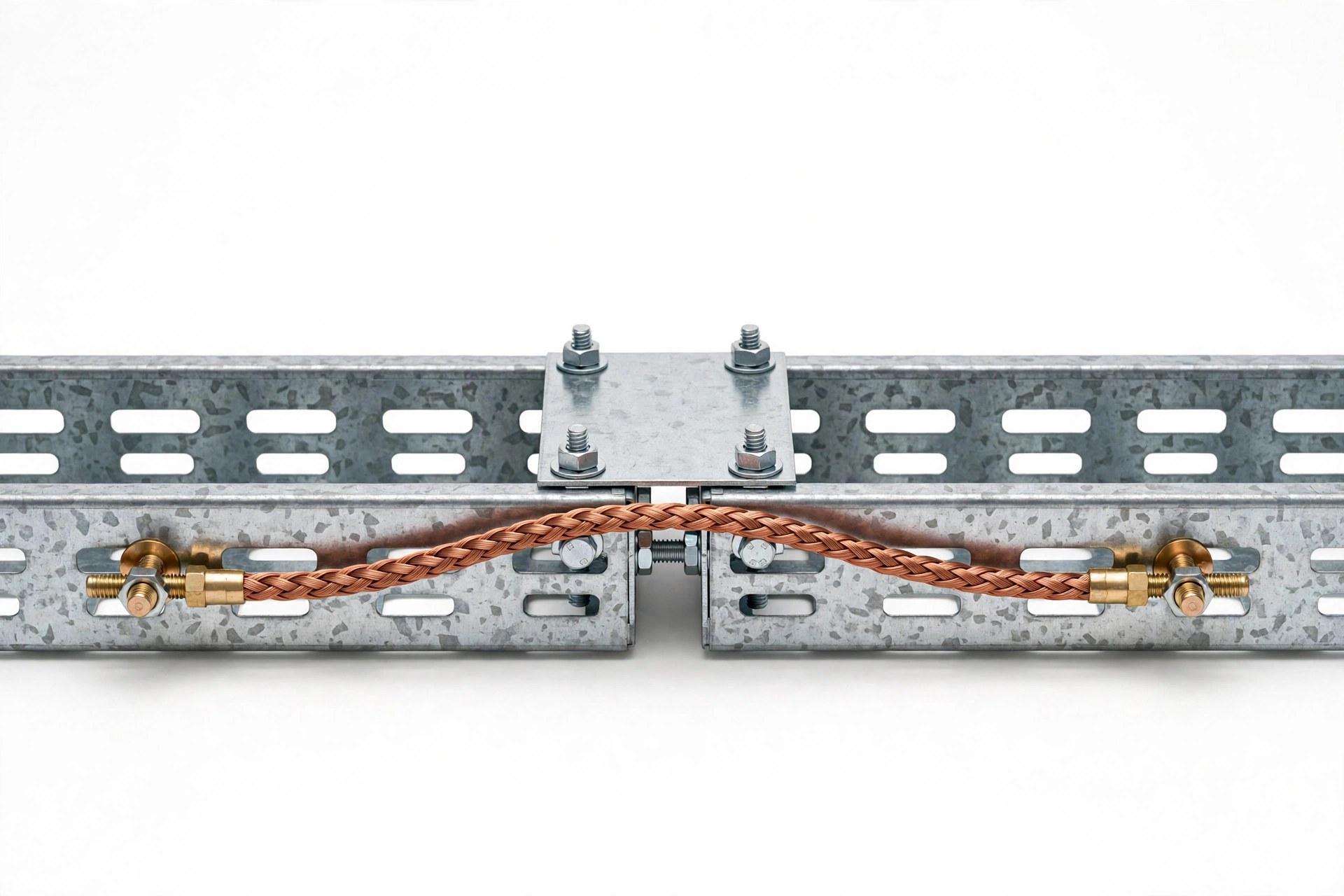
A tray run is made of 3-metre straight sections joined by couplers, and the couplers carry the electrical continuity across each joint. That makes the joint the part that matters most: a missed coupler, a coupler fitted loosely, or a joint where paint or powder coating sits between the mating faces breaks the continuity of the whole run. Check that couplers are fitted at every joint, because a run with one missed joint is not one earthed system.
Coated finishes need extra care. A powder-coated or painted tray is insulated at exactly the places the current must cross, so the design often specifies a bonding jumper across the joint as well as the coupler. Hot-dip galvanized and pre-galvanized finishes conduct through the joint more readily, but the design still states whether jumpers are required — never assume the finish alone is enough. Our cable tray finishes compared guide sets out how each finish behaves.
Bonding jumpers and earth lugs
A bonding jumper is a short braided copper conductor with lugs at each end, bolted across a tray joint so the current has a path even if the coupler faces are coated or corroded. An earth lug is the fitting that connects the tray run itself to the building earth, at the points the project design specifies. Both are small items, and both are usually ordered as separate lines in the fittings and accessories range — couplers, bonding straps and lugs counted from the drawings, not guessed.
Order them with the tray, not after it. A jumper that arrives with the shipment is fitted during installation; a jumper ordered later means a return visit, opened tray sections, and a continuity check done twice. Send the layout drawings with the BOQ and the fittings are counted from them.
FRP and non-metallic tray: a different answer
FRP tray does not conduct electricity, so it cannot be earthed as a conductor and its sections are not bonded to each other. Earthing on an FRP run is provided by a separate protective conductor run with the cables, as the project electrical design specifies. Do not fit bonding jumpers to FRP sections — there is no conductive path for them to protect, and the jumper would be decoration. Our FRP cable tray guide sets out where FRP belongs and where steel is the right answer.
What to specify on a BOQ
State the earthing on the BOQ in the same lines as the tray: the tray material and finish, couplers at every joint, bonding jumpers where the design requires them, earth lug points, and the separate protective conductor for any FRP run. A quotation that lists these as separate lines can be checked; a quotation that only lists tray lengths cannot. A cable ladder and a perforated tray take the same earthing items — the difference is in the tray, not in the bonding.
A short inspection checklist
- Every joint has its coupler fitted and tightened.
- Bonding jumpers fitted where the design specifies them.
- Earth lugs fitted at the points marked on the drawings.
- No joint left bare where the tray changes type or finish.
- Continuity checked across the run before handover, and written into the inspection record.
Ask for the continuity check to be written into the inspection plan before the work starts, not added at handover. Our cable tray installation guide covers supports, bends and the other checks that belong in the same plan.
Specifying earthing for a tray run?
Send your BOQ with the layout drawings — Jason replies personally with a priced offer, tray, couplers, bonding jumpers and lugs on separate lines.
Frequently asked questions
Does every tray joint need a bonding jumper?
No. Couplers carry continuity across joints where they are fitted correctly, and jumpers are specified where the design requires them — coated finishes, long runs, or areas the design calls out. The specification states which joints get jumpers.
Can the tray replace the earth wire?
Only if the project electrical design states so and continuity is verified. Otherwise a separate protective conductor is run with the cables. The quotation must answer the specification as written.
How is FRP tray earthed?
It is not earthed as a conductor, because FRP does not conduct. Earthing is provided by a separate protective conductor run with the cables, as the project electrical design specifies.
What should the quotation include for earthing?
Couplers at every joint, bonding jumpers where specified, earth lugs at the points the design marks, and the separate protective conductor for FRP runs — each as its own line, so the earthing can be checked.
Who checks continuity, and when?
The installer checks continuity across the run before handover, and the check is written into the inspection record. Ask for it to be in the inspection plan from the start, not added at handover.
Get a quotation for your project
Send your BOQ or drawings and the tray type, size, finish, and quantity you need. Quotations are prepared per BOQ — no fixed price list — and cover trays, fittings, and accessories to match. WhatsApp: +86 195 6350 7326 · Email: [email protected]