
FRP cable tray is made of fibreglass, not steel: unsaturated polyester resin reinforced with glass fibre. There is no metal in it to rust, and as an electrical insulator it does not conduct. That makes it the right tray in exactly the places where steel fails — chemical plants, wastewater treatment and corrosive process areas — and the wrong tray where the job is heavy loads and long spans.
| Question | Steel tray | FRP tray |
|---|---|---|
| Rust in chemical air | Coatings protect until cut or damaged, then rust starts | No metal to rust — the material itself resists |
| Electrical conduction | Conducts — needs earthing and bonding | Insulator — does not conduct or spark |
| Fittings at joints | Steel fittings, same finish as the tray | Molded in the same glass-fibre polyester |
| Load and span | Ladder carries heavy loads over long spans | Sizes, spans and loads confirmed per quotation |
What FRP cable tray is
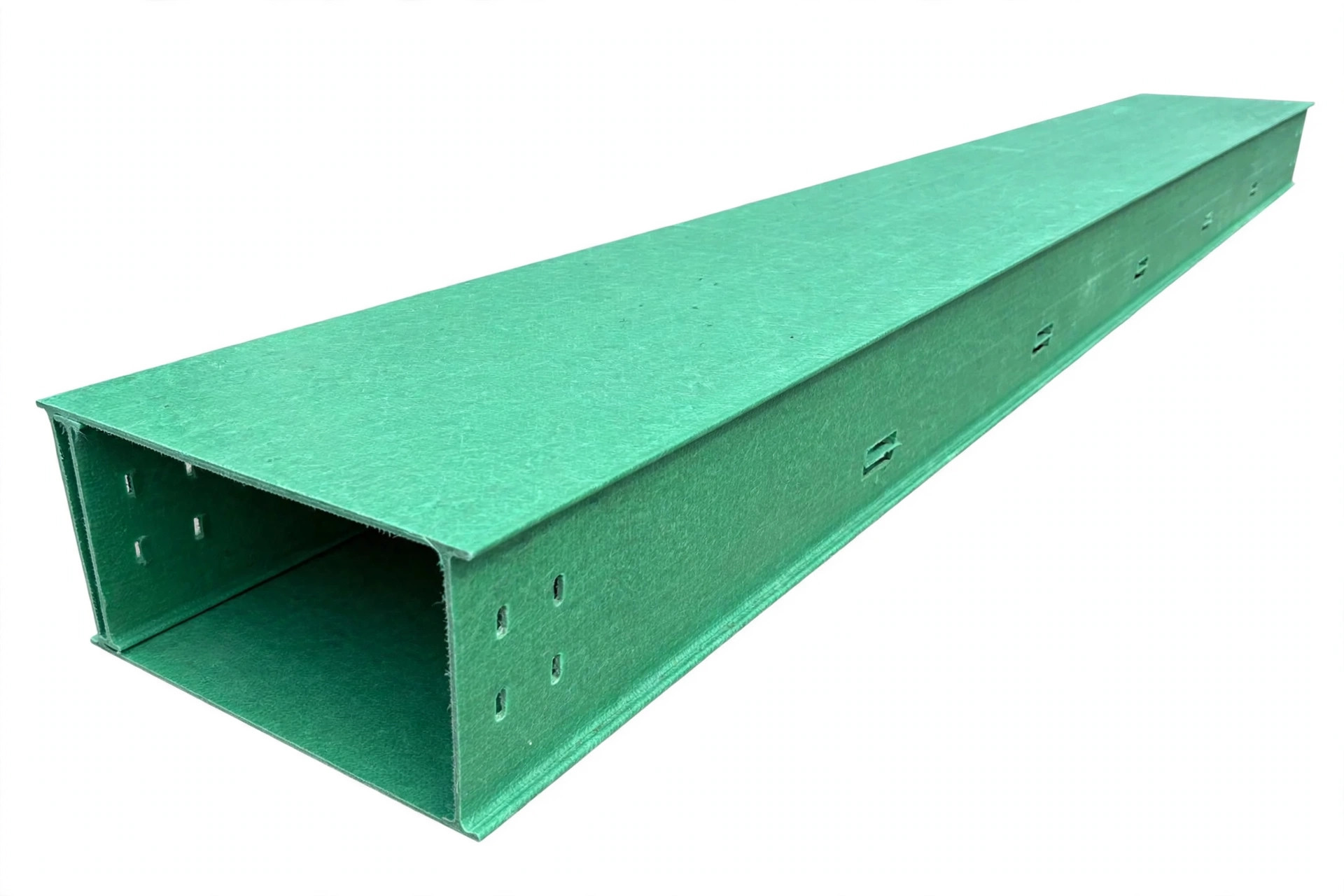
FRP — fibreglass reinforced plastic — cable tray is molded from unsaturated polyester resin reinforced with alkali-free glass fibre. There is no metal in it: nothing to rust, and as an electrical insulator it does not conduct, does not spark and is non-magnetic. Our FRP cable tray page lists the range: trough sections with matching covers, and bends, tees, crosses and covers molded in the same glass-fibre polyester, so a run never mixes materials at the joints.
The standard production colour is green; other colours are available on request. A flame-retardant grade is available at production for projects that specify it. There is no minimum order quantity for standard products, many commonly used sizes are kept in stock, and delivery is normally within 10 days except for very large orders — the exact lead time is confirmed with your quotation.
Where steel corrodes and FRP wins
Steel fails first where the air itself attacks it: chemical plants, wastewater treatment and corrosive process areas, where chemical vapours and washdowns attack coatings and metal. A galvanized or coated tray can hold for years indoors and fail quickly in those atmospheres, because every cut edge, drilled hole and scratched coating is a place for rust to start. FRP has no coating to fail — the corrosion resistance is the material, not a layer on it.
The same logic applies wherever washdowns are routine: the tray is hosed down, the water carries chemicals, and a steel tray spends its life wet. In those areas the choice is FRP, stainless steel to the grade the project specifies, or a polymer system — and the environment, not the price list, should settle it. Our cable tray finishes compared guide sets out where each steel finish belongs, and our stainless steel cable tray page covers the 304 and 316 grades.
Where FRP does not win
FRP is a different material family from steel, and it is not quoted off the steel load tables. Heavy power-cable loads and long spans belong on a steel cable ladder; FRP sizes, spans and loads are confirmed with your quotation, never read off a steel table. Send the width, the span, the cable load and the environment, and the quotation states the section and wall build selected for that duty — in writing, before you commit.
FRP is also produced to the project schedule rather than pulled from steel stock, so the quotation confirms the production slot together with the price. Where the environment is mild and the load is heavy, a hot-dip galvanized steel tray is the cheaper and stronger answer — FRP earns its place where corrosion, not load, is the problem.
Specifying FRP on a BOQ
Order FRP by the environment first and the size second. State the atmosphere the run passes through, the width and span, the cable load, the cover and fittings needed, and the colour and flame-retardant grade if the project specifies them. Anything outside the published range is confirmed with your quotation before it is ordered.
Because FRP is a different material family, the standard still applies: IEC 61537 covers cable tray systems including their performance and test requirements. The quotation states the section, the wall build and the standard — checkable lines, not a material name on its own. Our cable tray standards explained guide sets out what the standard covers and what to check.
Running cables through a chemical or wastewater area?
Send your BOQ with the environment each run passes through — Jason replies personally with a priced offer, FRP tray, molded fittings and covers on separate lines.
Frequently asked questions
Does FRP cable tray rust?
No. FRP contains no metal, so there is nothing to rust. Chemical vapours, washdowns and wastewater atmospheres attack coatings and steel, not the polyester and glass fibre the tray is molded from.
Can FRP tray carry power cables?
Yes, for normal loads. Heavy loads and long spans belong on a steel ladder. The size, span and load for your run are confirmed with your quotation, never read off a steel table.
What colours is FRP tray available in?
The standard production colour is green, and other colours are available on request. Covers are molded in the same material, so the colour matches across the run.
Is a flame-retardant grade available?
Yes, a flame-retardant grade is available at production for projects that specify it. State the requirement on the BOQ so it is built in, not added afterwards.
How is FRP tray earthed?
It is not — FRP does not conduct electricity, so it cannot be earthed as a conductor. Earthing is provided by a separate protective conductor run with the cables, as the project electrical design specifies.
Get a quotation for your project
Send your BOQ or drawings and the tray type, size, finish, and quantity you need. Quotations are prepared per BOQ — no fixed price list — and cover trays, fittings, and accessories to match. WhatsApp: +86 195 6350 7326 · Email: [email protected]